Extreme Heat Brings Summer Storms To Our Region
On July 4th, 2026 severe storms ripped through much of our region resulting in severe flooding. Monroe and Lehigh Counties were impacted by power outages, flooding, and downed trees.
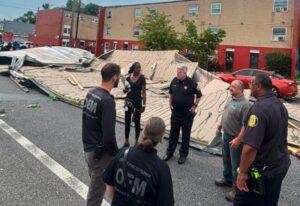
The following weekend, microbursts devastated neighborhoods in South and West Philadelphia.
A microburst is a sudden, powerful downdraft of sinking air within a thunderstorm, causing severe damage in only a few minutes, comparable to a small tornado. Philadelphia experienced four microbursts on Saturday July 11, 2026.
Powerful winds knocked over large oak, sycamore, and maple trees, damaging roofs, buildings and vehicles and causing widespread power outages.
So far, over 600 residents have self-reported damage to personal property, and food that has gone bad because of power outages. Some families have lost their homes entirely as currently they are not livable.
Many partners including the Pennsylvania Emergency Management, Philadelphia, Monroe, and Lehigh County Emergency Management, and fire departments are coming together with disaster partners including Lutheran Disaster Response, to support impacted families.
An effort is underway to get resources out to families quickly, and also to make sure that resources are available especially to low income families who are uninsured or underinsured.
What You Can Do
- If you live in Philadelphia and experienced damage from the storm, please fill out this short survey to help us assess the impact: gov/damagereporter. If you live outside of Philadelphia and experienced damage from recent storms, please report those damages directly to your municipal emergency manager
- Support your local food pantry
- Donate to Lutheran Disaster Response – Eastern PA.
LDR-Eastern PA works directly with impacted families, by helping them connect with volunteers and resources. Funds will be used to support volunteers, provide temporary housing and to meet basic household needs.
Leading the Way
As Pennsylvania grows hotter and weather patterns become more unpredictable, disasters are becoming more frequent and severe. At the same time, uncertainty around federal disaster funding is creating new challenges for communities across our state.
Lutheran Congregational Service’s (LCS) Julia Frank, who brings more than 20 years of experience in disaster response work, holds leadership positions at both the state and national Voluntary Organizations Active in Disaster (VOAD) levels.
Through her extensive network, she is leading a collaborative initiative with the Pennsylvania Emergency Management Agency (PEMA) and partners within PA-VOAD to prepare for storms like those in July and those yet to come.
A Grant to Build Capacity in Disaster Preparedness
To support these efforts, the Evangelical Lutheran Church of America (ELCA) Lutheran Disaster Response program provided a three-year grant totaling $300,000 to LCS.
These funds are being used to strengthen community capacity and resiliency, laying the foundation for a stronger, more coordinated disaster response system within Pennsylvania.
Collaborating with local and state government agencies, congregations, and community organizations, this initiative includes:
- Building volunteer capacity through recruitment, education, and training.
- Sharing stories of how communities like the Eastwick neighborhood of Philadelphia have strengthened resiliency in vulnerable neighborhoods, while encouraging others to build agency by applying both lessons learned and best practices from these communities
- Strengthening disaster response outreach, communication, and coordination among all partners.
Seeing the Benefits in Real Time
In the last year, LCS has made great progress in our disaster response work, thanks to this grant.
- One project is already showing great results. LCS and our partners are developing the Disaster Recovery Assistance Program (DRAP) Advocate volunteer role where volunteers from churches and other organizations assist people who have been through fires and floods to apply for a grant.
- LCS is working with Crisis Relief and Recovery to host workshops in several communities to build resilience and develop relief hubs.
These steps matter, as we are able to respond more quickly to local disasters. LCS and our partners are able to mobilize more quickly to reach those most in need.
Being Prepared for the Future
Disasters don’t wait until we’re ready. Yet when the next storm isn’t on the immediate horizon, preparedness is easy to postpone.
We need your help to navigate these challenging times and bridge the gap, especially for the most vulnerable in our neighborhoods. Please give today to our Lutheran Disaster Response program.